

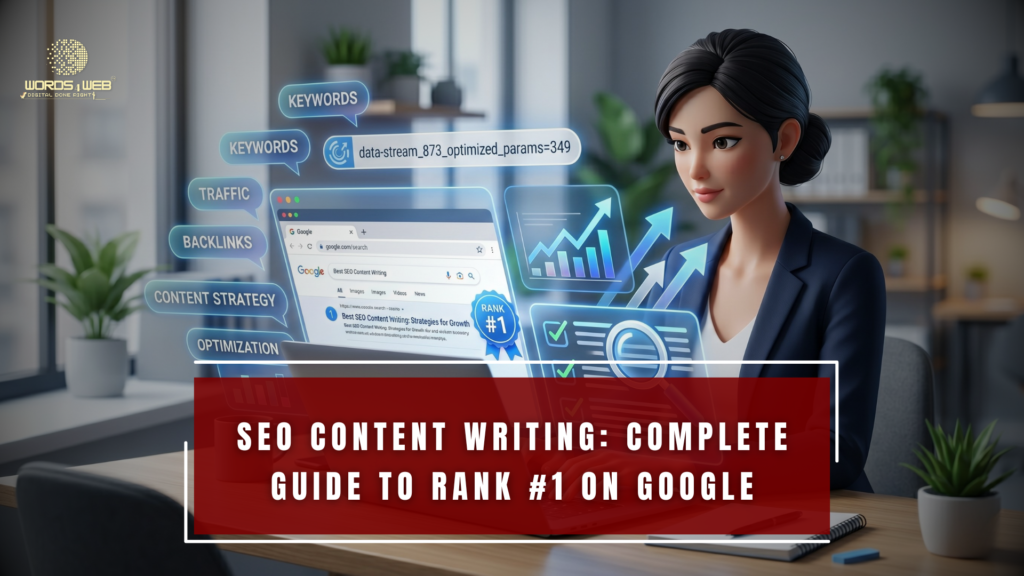
SEO Content Writing: Complete Guide to Rank #1 on Google
Have you ever spent three whole days writing a blog post, hit publish, and then watched it disappear somewhere on page 9 of Google, where, let’s be honest, nobody ever goes? That one stings. You did everything you thought was right. You wrote 1,200 words. You added headings. You even added a photo. And still, nothing. No clicks. No traffic. No enquiries. Just silence. If this sounds familiar, you’re not alone, and more importantly, you’re not doing something fundamentally wrong. You’re just missing the one thing that changes everything: SEO content writing. According to a study, over 90% of web pages get zero organic traffic from Google. That’s not a small problem; that’s an epidemic for online writers and business owners alike.
In this guide, we’re going to walk you through exactly how SEO content writing works in 2026 that gets results. Whether you’re exploring content writing for beginners or you’re already writing and want to finally crack the Google algorithm, this blog is for you.
Research from SEMrush confirms that long-form, well-structured content consistently outranks thin, keyword-stuffed pages. And data from Moz tells us that on-page SEO, which is largely about how you write, is one of the strongest ranking signals Google uses. So yes, what you write and how you write it genuinely matters. Let’s get into it.
SEO Content Writing: What It Actually Means (And Why Most People Get It Wrong)
Let’s clear something up straight away. SEO content writing is not about stuffing keywords into a paragraph until it sounds robotic. That approach died around 2012. Today, Google’s algorithm is smart enough to understand context, intent, and quality. What it’s actually looking for is content that genuinely answers a reader’s question in a clear, useful, and trustworthy way. Think of it this way: if someone typed that into Google, they want a recipe with ingredients, steps, and maybe a tip or two. Not a 500-word essay on the history of lentils.
SEO content writing combines three things: the right keywords, genuinely helpful information, and a structure that both readers and search engines can follow easily. According to Ahrefs, content that matches search intent, meaning it gives the user exactly what they were looking for, is the single biggest factor in ranking well. That’s a profound shift from the old way of thinking, where keywords alone were king.
And here’s the kicker: most people writing online today, including many professionals, are still writing for 2015’s Google. They focus on keyword density, meta tag tricks, and backlinks while ignoring the one thing that’s become non-negotiable: content quality paired with smart structure. Once you understand this shift, everything starts to make sense.
7 Core Principles of SEO Content Writing That Actually Work in 2026
These aren’t vague tips. These are the principles used by the world’s top-ranking content creators, backed by research from HubSpot, Ahrefs, and Moz. Apply them honestly and consistently, and the results will follow.
1. Start with Search Intent, Not Keywords
Before you write a single word, ask yourself: what does this person actually want? Are they looking for information, a product, a comparison, or a quick answer? HubSpot’s research shows that content aligned with search intent gets up to 3x more organic traffic than keyword-matched content that misses the intent entirely. It’s the difference between writing “best laptops under ₹40,000” for someone ready to buy versus someone just curious about specs. One earns the click. The other loses it.
2. Use a Clear, Logical Structure
Google reads your content the way a teacher reads an essay; it’s looking for a logical flow. Use one H1 for your title. Use H2S as your main section. Use H3S for sub-points within those sections. This is especially relevant if you’re studying content writing for beginners, because structure is something that often gets ignored early on. Semrush suggests that a well-structured article has a higher chance of earning featured snippet positions on Google. That small box at the top of search results that everyone wants? Structure gets you there.
3. Write for Humans First, Search Engines Second
This sounds obvious. But you’d be amazed at how many blogs read like they were written by a robot who has never met a person. Real content writing tips 2026-style thinking is simple: write the way you’d explain something to a smart friend over coffee. Use short sentences. Break up the big ideas. Be direct. If you find yourself re-reading a sentence three times to understand it, simplify it immediately.
Here’s a quick checklist for human-first writing:
- Read every paragraph out loud. If you trip over words, rewrite them
- Cut any sentence over 30 words into two sentences
- Replace technical jargon with plain words wherever possible
- Open each section with something the reader already feels or knows
- End each section with a clear takeaway or next thought
4. Do Keyword Research Properly, Then Use Keywords Naturally
Keywords are still important. Don’t let anyone tell you otherwise. But their role has changed. Instead of repeating the exact phrase fifteen times, you want to include it naturally in your title, first paragraph, one H2, and a few places in the body. Tools like Ahrefs’ free keyword generator and SEMrush’s Keyword Magic Tool can show you what real people are searching for right now. If you’re doing content writing India-focused work, you’ll often find that localised, long-tail keywordsthose four-to-six word phraseshave far less competition and convert much better than broad terms.
5. Optimise Your Meta Title and Meta Description
Your meta title is the clickable headline in Google results. Your meta description is the two-line summary beneath it. Together, they’re your shop window. If they’re boring or vague, nobody clicks, and Google takes click-through rates seriously as a ranking signal. A strong meta title includes your focus keyword, a number or power word, and stays under 60 characters. Your meta description should be under 160 characters, tell the reader exactly what they’ll get, and end with a subtle nudge to click. According to Moz, pages with well-written meta descriptions see a 5.8% higher average click-through rate. That’s significant, especially in competitive niches.
6. Internal Linking and Content Depth Matter More Than You Think
Every time you write a blog post, link it to at least two or three other relevant pieces of content on your site. This is called internal linking, and it does two things: it keeps readers on your site longer (which Google notices), and it helps Google understand the structure of your content. Depth also matters. A 300-word post on a complex topic tells Google you haven’t really covered it. Comprehensive content, typically 1,500 words or more, tends to rank significantly higher because it addresses more of the questions a reader might have. Analysis found that the average Google first-page result contains around 1,447 words. Food for thought.
7. Update Your Content Regularly
Google loves fresh content. A post you wrote in 2022 may still rank, but if the information is outdated and someone bounces off your page within 10 seconds, Google will gradually push you down. Make it a habit to review your top-performing posts every six months. Update statistics, add new examples, and fix any broken links. This single habit, often called content refreshing, has helped many content creators double their organic traffic without writing a single new post. It’s one of the smartest content writing tips for 2026 that still gets overlooked.
How to Learn SEO Content Writing: Courses, Certifications, and Real Skill-Building

Here’s where a lot of people feel stuck. They know they need to improve their writing skills. They Google “online content writing courses with certificates” or “seo content writing courses near me” and get absolutely overwhelmed by options. Some are free. Some cost ₹5,000. Some cost ₹50,000. Which ones actually work?
The honest answer is: it depends on where you’re starting from and what you need. Here’s how to think about it:
- If you’re a complete beginner: Look for structured courses with assignments, not just video lectures. You need to practise writing, not just watch someone else talk about it. Platforms offering certified SEO content writing online tend to be more credible if they include practical briefs, peer review, and real-world examples.
- If you already write but want SEO skills: You don’t need a full course. You need a focused 4-6 week programme on keyword research, on-page SEO, and content structuring. Pair this with tools like Ahrefs or Ubersuggest, and you’ll be ahead of 80% of content writers within three months.
- If you’re looking for a website content writing course in India: Prioritise ones that include localised examples, understand the global digital market, and cover content for international as well as Indian audiences, especially important if your target readers are in India or you’re writing for Indian businesses.
The most important thing? Don’t just collect certificates. Actually write. Publish. Analyse what works. HubSpot’s State of Marketing report found that marketers who prioritise blogging are 13x more likely to see a positive ROI. The gap between those who write consistently and those who don’t is enormous. So, yes, invest in learning. But invest even more in doing.
If you’re specifically searching for a certified seo content writing online programme that balances theory with practice, look for ones that include live feedback, portfolio-building opportunities, and tools training. Those three elements separate the programmes that genuinely transform your skills from the ones that just hand you a PDF certificate at the end. That’s what we are offering.
Common SEO Content Writing Mistakes (And Exactly How to Fix Them)
We’ve talked about what to do. Now let’s talk about what’s quietly sabotaging your rankings right now. These are the mistakes we see most often, and they’re all fixable.
Writing for Everyone: Which Means Writing for No One
The biggest mistake in content writing in India and globally is writing a blog that tries to speak to everyone. A post titled “Tips for Business” could mean anything to anyone. Narrow it down. Write for a specific person with a specific problem. The more specific your audience, the more powerful your writing becomes. Google also reads this specificity as topical authority, a major ranking factor in 2026.
Ignoring the First 100 Words
Your opening paragraph is the most important part of your post. If it doesn’t instantly connect with the reader through a question, a relatable situation, or a surprising fact, they’ll leave within 15 seconds. And Google will notice. Keep your intro tight. Make it emotional. Make it feel like you’re reading the reader’s mind. That’s the art of great SEO content writing.
Skipping the Call to Action
Every piece of content should guide the reader somewhere. To another blog post. To a contact form. To a course sign-up. Without a clear next step, even the best content leaves readers at a dead end. This is especially relevant for businesses using content writing strategies to generate leads; the CTA is where readers become customers.
Not Measuring What’s Working
You can’t improve what you don’t measure. Use Google Search Console (free) to see which posts are getting impressions and clicks. Use Google Analytics to see how long people are staying on your pages. If a post gets 500 impressions but only 5 clicks, your meta title needs work. If people are leaving after 20 seconds, your opening paragraph needs rethinking. Data is your most honest content writing teacher.
Conclusion
If there’s one thing we want you to take away from this guide, it’s this: SEO content writing is not a dark art. It’s a learnable skill that sits right at the intersection of good writing and smart strategy. You don’t need to be a tech genius or a marketing veteran. You need to understand your reader, write clearly for them, and give Google the signals it’s looking for. That’s it. Every principle in this guide, from search intent to content structure to regular updates, is something anyone can apply starting today. And once you do, the results compound. Good content builds on itself.
Whether you’re in Mumbai, Delhi, Bangalore, Hyderabad, or anywhere else across the globe, the rules of SEO content writing are the same, and the opportunity is wide open. If you’re ready to stop guessing and start writing with real purpose, Words4web is here to help. We offer practical, result-focused online content writing courses with certificates, tailored specifically for the digital market. From seo content writing courses near me-style live sessions to self-paced certified seo content writing online programmes, we’ve built everything you need to go from hesitant beginner to confident, employed writer. Enrol in our content writing course and take the first step towards writing content that actually ranks.
FAQs
1. What is SEO content writing in simple words?
SEO content writing is writing blog posts, website pages, or articles in a way that both real people and Google can easily understand. It involves using the right words (keywords), organising content clearly, and genuinely answering what someone was searching for. When done well, your content ranks higher on Google and brings in consistent, free traffic.
2. Is SEO content writing a good career in India?
Absolutely. Content writing in India is one of the fastest-growing digital careers right now. Businesses of all sizes, from startups to large corporations, need consistent, quality content to stay visible online. Skilled SEO content writers with a strong portfolio and certified training are in high demand, with freelance rates ranging from ₹1 to ₹5 per word and full-time roles paying between ₹3.5 to ₹8 LPA for beginners.
3. How long does it take to rank on Google with SEO content?
Realistically, it takes between 3 and 6 months for a well-optimised piece of content to rank on Google’s first page, assuming your website has some existing authority. New websites may take longer. Consistency matters enormously here. Publishing one high-quality post per week over six months will almost always outperform publishing ten posts in one month and then going quiet.
4. Do I need a course to learn SEO content writing?
A structured course accelerates your learning significantly, especially if you’re starting. While free resources are valuable, a good course, whether it’s a website content writing course in India or a certified SEO content writing online program, gives you a framework, feedback, and the confidence to write professionally. The key is to apply what you learn immediately. Practice is what turns knowledge into skill.
Disclaimer- The information provided in the content is for educational purposes only and is written by a professional writer. Contact us to learn more about SEO content writing.
Citation:
- https://ahrefs.com/blog/search-traffic-study/
- https://www.semrush.com/blog/seo-content/
- https://moz.com/learn/seo/on-page-factors
- https://ahrefs.com/blog/seo-content/
- https://www.semrush.com/blog/featured-snippets/
- https://ahrefs.com/keyword-generator
- https://www.semrush.com/features/keyword-magic-tool/
- https://moz.com/learn/seo/meta-description
- https://www.hubspot.com/marketing-statistics